Power Hauling and Equipment Transport Services

Why does it even matter?
Power hauling is not just about moving iron from one address to another. The wrong trailer, weak loading plan, or missed permit can delay a jobsite, damage equipment, or create a roadside safety issue. In Southern Ontario, tight delivery windows and mixed urban and rural routes make planning even more important.
Moving equipment for construction, agriculture, and industrial work
Each sector creates different hauling demands. A compact excavator headed to a residential build has different clearance, access, and timing needs than a farm tractor moving between fields or a scissor lift going into an industrial plant. Versatile companies like HowieBins offers power hauling for exactly these types of scenarios across Southern Ontario.
A common mistake is treating all equipment as a standard load. Weight distribution, attachment position, and site access can change the transport method. If those details are missed, loading can take longer than expected or require a second truck.
- Construction loads often need quick turnaround and tight site entry
- Agricultural moves may involve soft ground and seasonal road limits
- Industrial equipment can require stricter timing and controlled unloading areas
Scheduled hauling and emergency response are not the same job
Scheduled transport allows time to confirm dimensions, route limits, and site readiness. Emergency hauling usually happens after a breakdown, job delay, or equipment failure, so speed matters more, but rushed decisions create risk.
The biggest failure point in urgent moves is incomplete equipment information. If the hauler arrives without the right deck height, tie-down capacity, or winch setup, the machine may still sit in place. In Southern Ontario, that can mean missed contractor schedules and extra labour costs on site.
Oversized loads need route and compliance planning
Oversized machinery, wide attachments, and tall units cannot be treated like standard freight. Route selection has to account for bridge clearances, road restrictions, turning radius, and permit requirements before the truck rolls.
Transport service often breaks down at the pickup or delivery point, not on the highway. A machine may be ready to move, but the site may lack ramps, forklift support, level ground, or enough space to position the trailer safely.
Door-to-site coordination includes loading and unloading support
One bad assumption can stop the move halfway through the day. That is why teams handling oversized transport need to work from actual measurements, not model specs pulled from memory. Practical planning usually starts with Ontario machinery moving regulations, especially when width, height, or axle loads push the job outside normal limits.
Good coordination covers more than dispatch times. It also confirms who is loading the machine, who is spotting the driver, and whether the delivery site can handle unloading without blocking work crews. If that handoff is vague, damage usually happens during the first or last ten minutes of the job.
Regional transport planning across Southern Ontario
Short-distance hauling still needs detailed planning. A move across town can be harder than a longer highway run if the route includes tight entrances, traffic restrictions, or limited staging space.
Regional transport adds another tradeoff. The fastest route is not always the safest route for loaded equipment. In some cases, a slightly longer path reduces sharp turns, overhead conflicts, and delays at busy intersections. That matters when a machine needs to arrive ready to work, not shifted or stressed from a poor haul.
Choosing the right trailer for compact and mid-size equipment
Trailer selection affects safety, loading speed, and legal compliance. Skid steers, mini excavators, boom lifts, and other compact units may look easy to move, but deck length, ramp angle, axle rating, and tie-down points still have to match the load.
A common error is using a trailer that technically holds the weight but does not balance the machine well. That can overload one axle or leave attachments positioned badly. Matching the trailer to compact equipment types helps avoid those fit and stability problems before dispatch.
- Skid steers often need careful bucket placement for balance
- Excavators need enough deck room for boom and track position
- Lifts can require lower deck heights to manage overall clearance
What to confirm before booking a haul
The best moves start with exact information. Dimensions, operating weight, attachment details, pickup access, and unloading conditions should all be confirmed before the truck is assigned.
If any of those details are missing, the haul can cost more and take longer than planned. Clear job information usually makes the difference between a smooth same-day move and a transport problem that follows the equipment to the next site.
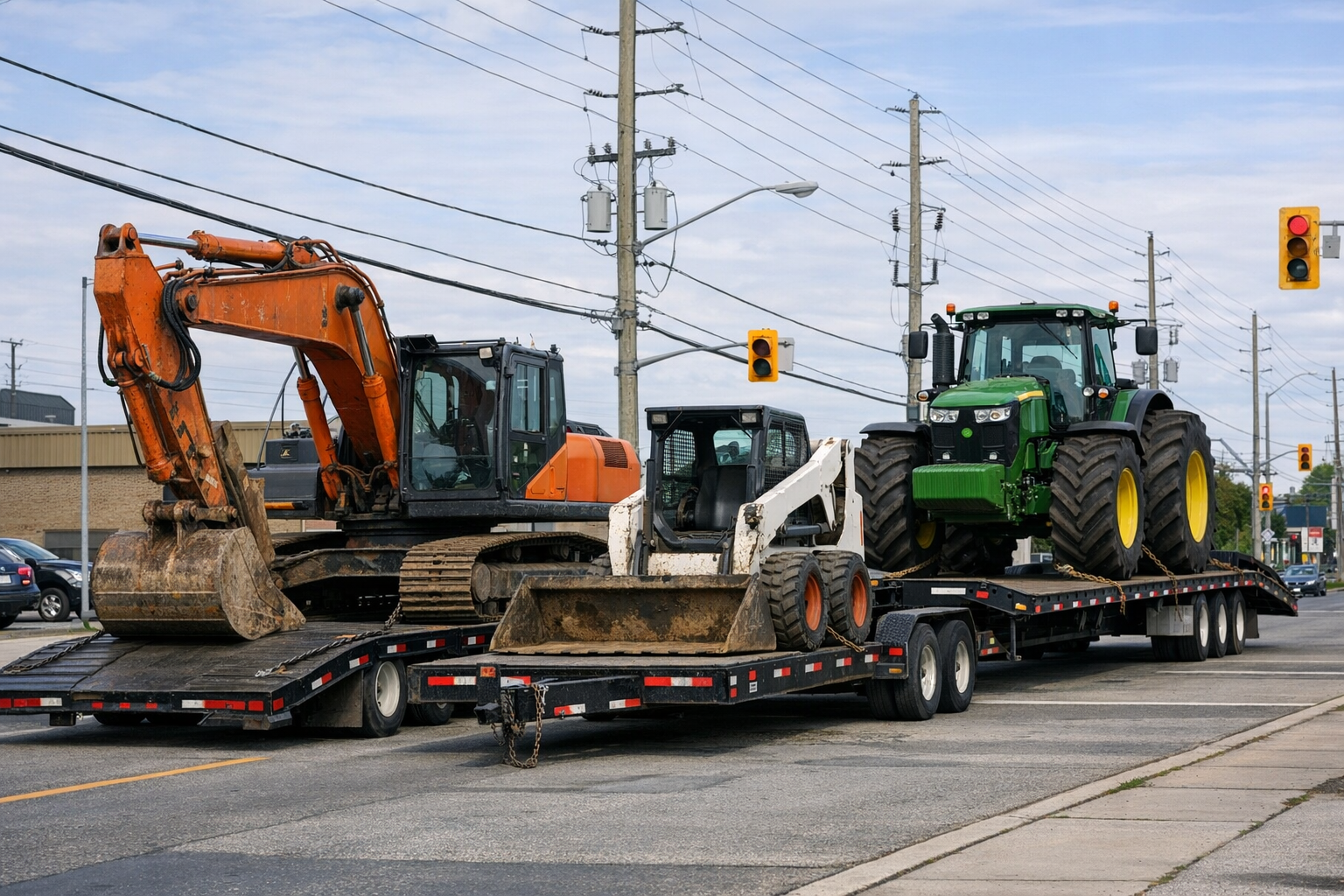
Types of equipment commonly transported in Southern Ontario
Equipment transport in Southern Ontario covers a wide mix of machines, sizes, and load profiles. Each category creates different hauling, securement, and routing demands. If the wrong trailer or tie-down plan is used, delays, damage, and compliance issues show up fast.
Earthmoving machines need weight and balance planning
Excavators, bulldozers, backhoes, and wheel loaders are some of the most common loads on local routes. They are heavy, wide, and often awkward to position on a trailer.
The main challenge is axle weight distribution. A machine can fit on the deck and still create an illegal or unstable load if the boom, blade, or bucket shifts too much weight forward or back.
- Excavators often need boom and bucket positioning to reduce overall transport height
- Bulldozers can trigger width concerns, especially with outside blade edges
- Wheel loaders may need bucket removal or careful placement to control length
A common mistake is loading for convenience instead of balance. That can lead to tire overload, poor braking control, or a reload at the scale.
Aerial and warehouse equipment has different transport risks
Forklifts, scissor lifts, boom lifts, and telehandlers are moved every day between jobs, warehouses, and rental yards. They may look simpler than large earthmoving machines, but they bring their own problems.
Boom lifts and telehandlers add another constraint, folded length does not always mean low height. A poor route choice can create bridge clearance issues long before the truck reaches the site.
Skid steers, compact track loaders, and mini excavators are common because they fit smaller sites and tighter access points. They also move often, which increases the chance of rushed loading.
Compact equipment is easier to move, but easy to underestimate
The failure mode here is usually complacency. Operators may treat compact machines as simple loads, then overlook attachment removal, track condition, or loose buckets and couplers.
Forklifts are compact, but their center of gravity can be tricky. Mast position, attachment weight, and solid tires all affect how the machine sits during transport, especially with powered lift trucks used on industrial sites.
Mini excavators can be light enough for smaller trailers, but attachment combinations change total weight quickly. Compact track loaders also need attention to mud buildup and track wear, since both affect securement and deck traction.
Site support equipment still needs proper securement
Generators, compressors, pumps, and other support units do not always draw the most attention, but they can create real hauling issues. Many are towable, while others are skid mounted or enclosed.
The tradeoff is speed versus preparation. A crew may want to move a generator quickly between sites, but loose cables, fuel caps, panels, or hose reels can turn a routine move into equipment damage.
Farm machinery, utility equipment, and specialized attachments round out a big share of transport work in Southern Ontario. These loads can vary more than standard construction machines.
Farm and utility equipment often comes with awkward dimensions
Mixed loads also complicate the trailer plan. If a support unit shares deck space with an excavator and skid steer, the tie-down layout has to account for different anchor points, different heights, and safe unloading order.
A mower attachment, trencher, auger, or material bucket may not weigh much on its own, but odd shapes make securement harder. The result is often wasted deck space or extra trips if the trailer was planned around weight alone.
- Farm implements can be wide even when total weight is moderate
- Utility units may include booms, reels, or outriggers that change load height
- Specialized attachments need their own tie-down points, not just chain around the frame
The practical takeaway is simple. The machine type tells only part of the story. Dimensions, attachment setup, and trailer fit usually decide how smooth the move will be.


Post Comment